240.4 Protection of Conductors
Conductors, other than flexible cords, flexible cables, and fixture wires, shall be protected against overcurrent in accordance with their ampacities specified in 310.14, unless otherwise permitted or required in 240.4(A) through (G).
Informational Note: See ICEA P-32-382-2007 (R2013), Short Circuit Characteristics of Insulated Cables, for information on allowable short-circuit currents for insulated copper and aluminum conductors.
Informational Note: See NFPA 20-2013, Standard for the Installation of Stationary Pumps for Fire Protection.
(B) Overcurrent Devices Rated 800 Amperes or Less
The next higher standard overcurrent device rating (above the ampacity of the conductors being protected) shall be permitted to be used, provided all of the following conditions are met:
- The conductors being protected are not part of a branch circuit supplying more than one receptacle for cord-and-plug-connected portable loads.
- The ampacity of the conductors does not correspond with the standard ampere rating of a fuse or a circuit breaker without overload trip adjustments above its rating (but that shall be permitted to have other trip or rating adjustments).
- The next higher standard rating selected does not exceed 800 amperes.
(C) Overcurrent Devices Rated Over 800 Amperes
(D) Small Conductors
(1) 18 AWG Copper
- Continuous loads do not exceed 5.6 amperes.
- Overcurrent protection is provided by one of the following:
- Branch-circuit-rated circuit breakers listed and marked for use with 18 AWG copper wire
- Branch-circuit-rated fuses listed and marked for use with 18 AWG copper wire
- Class CC, Class J, or Class T fuses
(2) 16 AWG Copper
- Continuous loads do not exceed 8 amperes.
- Overcurrent protection is provided by one of the following:
- Branch-circuit-rated circuit breakers listed and marked for use with 16 AWG copper wire
- Branch-circuit-rated fuses listed and marked for use with 16 AWG copper wire
- Class CC, Class J, or Class T fuses
(3) 14 AWG Copper
(4) 12 AWG Aluminum and Copper-Clad Aluminum
(5) 12 AWG Copper
(6) 10 AWG Aluminum and Copper-Clad Aluminum
(7) 10 AWG Copper
(E) Tap Conductors
Tap conductors shall be permitted to be protected against overcurrent in accordance with the following:
- 210.19(A)(3) and (A)(4), Household Ranges and Cooking Appliances and Other Loads
- 240.5(B)(2), Fixture Wire
- 240.21, Location in Circuit
- 368.17(B), Reduction in Ampacity Size of Busway
- 368.17(C), Feeder or Branch Circuits (busway taps)
- 430.53(D), Single Motor Taps
(F) Transformer Secondary Conductors
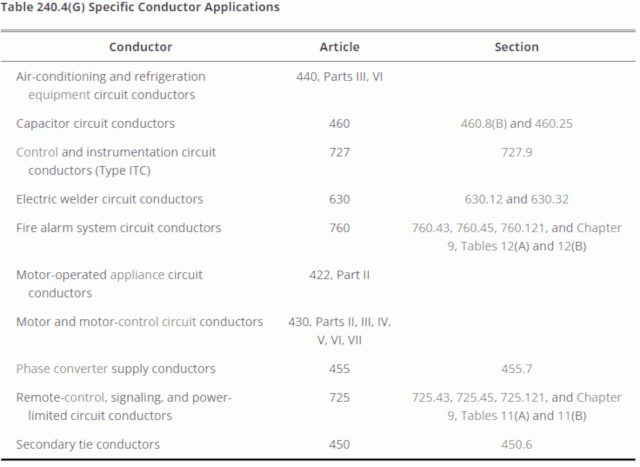
(G) Overcurrent Protection for Specific Conductor Applications
NEC – Conductors and protection for air-conditioning equipment (Based on the 2011 NEC)
https://www.youtube.com/watch?v=9lPDYEAgWD4
Disclaimer: Inspector-IQ takes reasonable efforts to ensure that the contents of its website are accurate. While every effort has been made to ensure the accuracy and completeness of the content of Inspector-IQ.com, no warranty or fitness is provided or implied, and Inspector-IQ, its partners, supporters, employees, or associated organizations shall have neither liability nor responsibility to any person or entity with respect to any loss or damage arising from its use.
Last Updated on 2 years ago