Code Change Summary
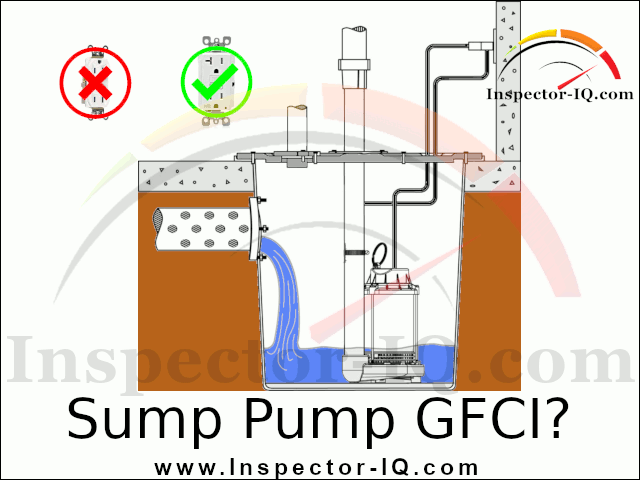 The 2020 NEC revisions do clarify the sump pump GFCI requirements. Whereas, Section 210.8 provides GFCI requirements for certain receptacles and outlets whereas Section 422.5 provides GFCI protection requirements for specific appliances, whether cord-and-plug-connected or hard-wired.
The 2020 NEC, the GFCI requirements for specific appliances were revised to clarify that the GFCI protection must be Class A. The previous language just required GFCI protection in general which left the door open to Special Purpose GFCI devices that trip after higher levels of current leakage are detected than a Class A device. The Class A GFCI device provides the best protection for personnel and is designed to trip when between 4 mA and 6 mA of current leakage to ground is detected.
The language in item (4) was shortened up and now GFCI protection is required for all tire inflation machines rather than those only for the public.
Additional revisions now include bottle fill stations, sump pump GFCI requirements, and ALL dishwashers among the list of appliance types that will require GFCI protection (if operating within the voltage and current levels in the parent text of 422.5(A)). In the 2017 NEC, only dwelling unit dishwashers required GFCI protection in accordance with 210.8(D). This language was shortened up and relocated to 422.5(A) in the 2020 NEC and now applies to all dishwashers.
2020 Code Language:
422.5(A) General. Appliances identified in 422.5(A)(1) through (A)(7) rated 150 volts or less to ground and 60 amperes or less, single- or 3-phase, shall be provided with Class A GFCI protection for personnel. Multiple Class A GFCI protective devices shall be permitted but shall not be required.
(1) Automotive vacuum machines
(2) Drinking water coolers and bottle fill stations
(3) Cord-and-plug-connected high-pressure spray washing machines
(4) Tire inflation machines
(5) Vending machines
(6) Sump pumps
(7) Dishwashers
Informational Note: Section 210.8 specifies requirements for GFCI protection for the branch-circuit outlet where the covered location warrants such protection.
Additional information can be found at
2017 GFCI Code Requirements can be found by clicking this link.
Disclaimer: Inspector-IQ takes reasonable efforts to ensure that the contents of its website are accurate. While every effort has been made to ensure the accuracy and completeness of the content of Inspector-IQ.com, no warranty or fitness is provided or implied, and Inspector-IQ, its partners, supporters, employees, or associated organizations shall have neither liability nor responsibility to any person or entity with respect to any loss or damage arising from its use.
Last Updated on 3 years ago